Alternative Water Solutions for Urban Development
Rotterdam, February, 2026
As cities continue to grow, water is becoming a critical challenge in urban development. Centralized water systems are struggling to keep pace with population growth, climate variability, and rising demand, while freshwater availability and water quality face increasing climate-related pressures. As a result, water can no longer be treated as a background utility in project planning, and planners and developers are turning to alternative water solutions to reduce dependency and strengthen long-term resilience.
Main alternative water solutions
The growing need for more sustainable and resilient water management has led to the development of a wide range of alternative solutions.
From technologies that generate water locally to systems that capture, reuse, or treat existing sources, these approaches are increasingly being integrated into urban projects. Together, they offer new ways to reduce pressure on centralized networks while strengthening long-term water security.
On Site Water Generation
In addition to conventional water sources, some urban developments are beginning to explore ways to generate drinking water directly on site. Air-to-water generators extract moisture from surrounding air and convert it into drinking water through condensation and purification, producing water without the need for a traditional water source. This approach is particularly suitable for hot and humid urban environments, where atmospheric moisture offers a reliable, locally available resource.
Rainmaker Holland’s Air-to-Water generators enable on-site water production. These systems enable on-site water production, reduce reliance on centralized supply networks, and can be scaled to meet varying levels of demand, supporting water resilience in areas where freshwater availability is limited or unreliable.
Closing the Loop Through Water Reuse
Resilient urban water systems depend not only on supply, but also on how water circulates within them. After water serves its first purpose, much of it can continue to add value by being reused for non-potable applications such as toilet flushing or landscape irrigation, rather than returning immediately to the sewer. For example, greywater reuse systems capture lightly contaminated water from everyday activities such as showering, handwashing, and laundry, and treat it for reuse within the same development. By closing the loop, it helps urban projects reduce their reliance on potable water supply and move away from a single-use mentality toward a more circular approach to water management. Within such systems, solutions like Rainmaker Holland’s Water-to-Water generators can help enable safe reuse by treating available water streams locally.
Rainwater Harvesting
Large volumes of rainfall are often treated as runoff to be managed rather than a resource to be used. Rainwater harvesting rethinks this approach by capturing and storing rain from roofs and other surfaces for later use within urban developments. Once collected, this water can serve everyday functions such as irrigation, cleaning, or toilet flushing, and with appropriate treatment and filtration it can even provide a local tap water source for communities. By putting rainfall to work, rainwater harvesting reduces pressure on municipal systems while also helping to manage stormwater runoff and lower flood risks in dense urban environments. To deliver these benefits reliably, these systems are most effective when capture, storage, and treatment are considered together; an approach supported by Rainmaker Holland in integrated urban water projects.
Smart water management
Smart water management solutions use digital tools to monitor water flows, detect leaks, and optimize demand. While these systems do not create new water sources, they play a crucial role in improving efficiency and reliability across both conventional and alternative water systems. Solutions such as Rainmaker Holland’s monitoring options extend this approach by providing real-time insights into system performance, water quality, and output. For urban planners, smart management supports data-driven decision-making and helps ensure that water infrastructure performs as intended over time.
Matching Solutions with a Holistic Approach
In water-stressed or coastal urban areas, water strategy requires a holistic approach that considers how different solutions interact across scales, from individual buildings to entire cities. Alternative water solutions can be applied at multiple levels depending on project size, local context, and development objectives, and are most effective when planned as part of an integrated system rather than as isolated interventions.
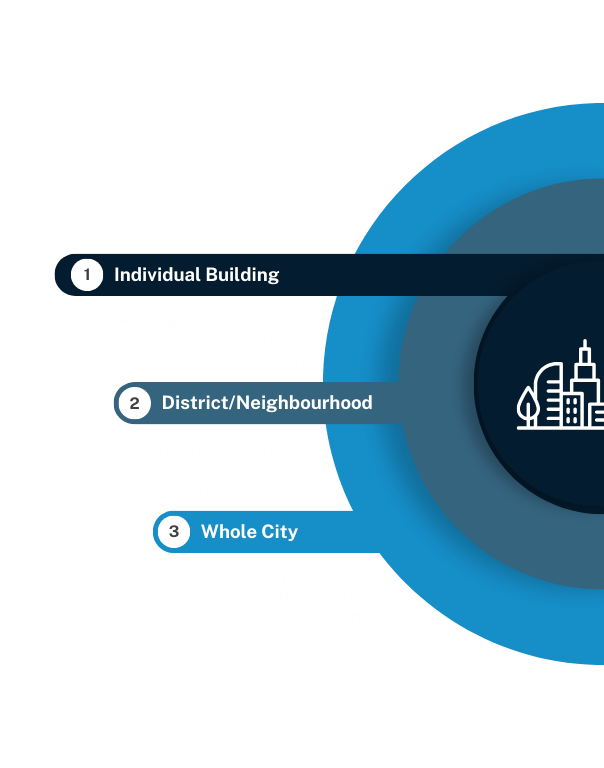
When looking at an individual building, developers can integrate on-site water generation, rainwater harvesting, and greywater reuse directly into building design. This may include installing air-to-water systems to supply part of the drinking water demand, capturing roof runoff for non-potable uses, reusing greywater for toilet flushing, and implementing smart monitoring to track consumption and detect leaks. These measures reduce long-term reliance on external supply and improving operational efficiency.
At the district or neighbourhood level, planners can coordinate shared infrastructure across multiple buildings. Examples include decentralized wastewater treatment facilities serving a cluster of developments, shared water reuse systems, or nature-based solutions at district-scale such as constructed wetlands. By combining water flows and treatment capacity, districts can benefit from economies of scale while reducing pressure on centralized networks and improving overall system resilience.
When looking at a whole city, holistic water planning often means combining centralized water infrastructure with decentralized and alternative sources. Cities can support this by allowing and encouraging local water generation and reuse through zoning rules, building codes, or development guidelines, while making sure these solutions work alongside existing networks. By taking this approach, cities can create more flexible water systems that are better able to cope with growth, changing climate conditions, and limits in existing infrastructure.
By implementing these measures in a coordinated way, planners and developers can turn holistic water strategies into resilient urban systems.
Implications for urban developers and investors
For urban developers and investors, water strategy is increasingly linked to project risk, operational stability, and asset value.
By integrating alternative water solutions into project planning, developers can reduce dependency on external infrastructure, improve resilience, and create assets that are better prepared for changing environmental and regulatory conditions.
The future of urban water planning
Over the coming decade, urban water planning is expected to move toward more diversified and adaptive systems. Rather than relying on a single source or centralized network, cities are increasingly exploring combinations of local sourcing, reuse, and decentralized treatment to improve resilience; in line with Sustainable Development Goal 6 on clean water and sanitation.
Water is also becoming more closely linked to broader urban resilience strategies, alongside energy, mobility, and climate adaptation planning. This shift reflects a growing recognition that urban water systems must be designed to cope with uncertainty and long-term change, rather than optimized solely for past conditions.
Conclusion
Alternative water solutions are becoming a fundamental component of resilient urban development.
By integrating decentralized, local, and circular water systems into project planning, cities can reduce dependency on overstretched infrastructure and better prepare for future uncertainty.
For planners, developers, and decision-makers, it’s important to work with specialist in the water sector who can guide on how water is sourced, treated, and managed, as it is no longer optional. Water is no longer just a utility, it is a strategic resource that supports sustainable, adaptable, and resilient urban environments.